Solar panels spend most of their lives exposed to the outdoors. Sun, rain, wind, dust, leaves, and other environmental conditions are all part of normal operation. But there is another issue many homeowners do not consider until it happens: wildlife getting underneath the panels. The space between roof-mounted solar panels and the roof can provide shelter from weather and predators. Birds may use this protected space for roosting or nesting, and other pests may also find access underneath an array. Research has documented birds using the underside of photovoltaic panels for activities including nesting and roosting.
Once animals move into this space, nesting material, feathers, droppings, and other debris can accumulate around the array. That is where solar panel guards can help. A properly designed guard creates a physical barrier around the accessible edges of the array, making it harder for wildlife to enter while still allowing the solar system to remain accessible for appropriate maintenance.
- Quick Answer
- What Are Solar Panel Guards?
- Why Do Birds and Pests Get Under Solar Panels?
- How Do Solar Panel Guards Protect Your Panels?
- 1. They Help Prevent Bird Nesting
- 2. They Help Reduce Nesting Debris
- 3. They Help Protect the Area Around Wiring
- 4. They Can Reduce Maintenance-Related Problems
- What Are the Main Benefits of Solar Panel Guards?
- Protection from birds and some pests
- Less nesting material
- Easier future maintenance
- Protection for the surrounding roof area
- Long-term preventive maintenance
- Do Solar Panel Guards Affect Airflow?
- Can Solar Panel Guards Damage Solar Panels?
- Can Solar Panel Guards Affect the Warranty?
- Signs You May Need Solar Panel Guards
- What Should You Check Before Solar Panel Guard Installation?
- Check the condition of the solar panels
- Check for existing nests
- Inspect the roof
- Ask about the attachment method
- Solar Panel Guards vs. Other Bird Deterrents
- Should You Install Solar Panel Guards Yourself?
- Why Professional Installation Can Be Useful
- Do Solar Panels Still Need Cleaning After Guards Are Installed?
- Common Solar Panel Guard Mistakes
- Installing a guard without checking for existing wildlife
- Choosing a product based only on price
- Ignoring the attachment method
- Blocking access for future maintenance
- Assuming guards eliminate every wildlife problem
- Ignoring the roof
- Key Takeaways
- Conclusion
- Frequently Asked Questions
Quick Answer
Solar panel guards are physical barriers installed around the edges of a solar panel array to help prevent birds, rodents, and debris from getting underneath the panels. They can reduce nesting-related mess, protect access to wiring and other components, and make ongoing maintenance easier. The installation method matters, so guards should be fitted without damaging the panels, roof, or mounting system.
What Are Solar Panel Guards?
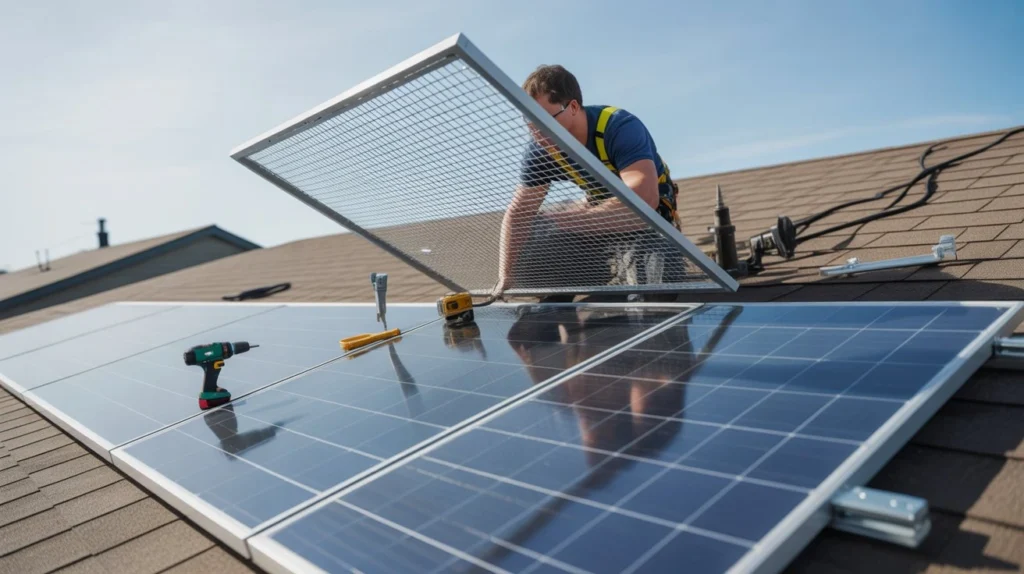
Solar panel guards are protective barriers, commonly made from mesh or similar materials, that are installed around the perimeter of roof-mounted solar panels.
The purpose is simple: close the accessible gap beneath the panels so birds and other pests have less opportunity to get underneath them.
Unlike a chemical repellent, a physical guard does not depend on an animal avoiding a smell, sound, or visual deterrent. It works by restricting physical access.
Depending on the product and solar array, guards may be secured using clips or other attachment methods designed for the panel and mounting configuration.
The exact material and fastening system matter because the barrier needs to remain secure without damaging the solar equipment or interfering with necessary maintenance.
Why Do Birds and Pests Get Under Solar Panels?
Solar panels can create an attractive sheltered space.
The area underneath an array may provide:
- Protection from direct weather
- A relatively undisturbed nesting location
- Shelter from some predators
- Elevated access away from ground-level activity
- A protected area for nesting material
Birds are known to interact with photovoltaic installations, including using the underside of panels for nesting and roosting.
Once nesting begins, the problem can become more than an occasional bird visiting the roof.
Twigs, feathers, leaves, droppings, and other material can accumulate underneath the array. Depending on the system and the type of wildlife involved, cables and other components may also become exposed to unwanted contact.
How Do Solar Panel Guards Protect Your Panels?
The main function of a guard is exclusion.
Instead of trying to remove animals after they have already established a nesting location, the barrier limits access to the space underneath the panels.
1. They Help Prevent Bird Nesting
Birds are one of the most common reasons homeowners consider solar panel guards.
If birds can enter the open perimeter of an array, they may establish nests beneath the panels. A correctly installed mesh barrier can close that access point.
This does not mean every bird-related problem disappears. Birds may still perch on or around the array, and droppings can still land on exposed surfaces.
The guard’s primary purpose is to prevent access underneath the panels.
2. They Help Reduce Nesting Debris
A nest can contain twigs, grass, feathers, leaves, and other materials.
When this material accumulates beneath solar panels, it can make inspection and cleaning more difficult.
A physical exclusion barrier can reduce the amount of new nesting material entering the protected space.
3. They Help Protect the Area Around Wiring
Solar arrays contain electrical wiring and other components beneath the panels.
Keeping wildlife out of the underside of the array can help reduce opportunities for animals to interact with those components.
However, a solar panel guard should not be described as a guarantee against electrical damage. Existing cable damage, loose connections, or other electrical problems require appropriate inspection by a qualified professional.
4. They Can Reduce Maintenance-Related Problems
When birds establish nests beneath panels, homeowners may eventually need to deal with:
- Nest removal
- Debris cleanup
- Dropping cleanup
- Inspection of the area underneath the array
- Wildlife-related damage
- Roof or gutter debris
Preventing access in the first place can reduce some of these recurring maintenance concerns.
What Are the Main Benefits of Solar Panel Guards?
The value of a guard is not simply that it makes the panels look cleaner.
Its broader benefit is protecting the space around the solar installation from unwanted wildlife activity.
Protection from birds and some pests
A perimeter barrier can restrict access beneath the array for birds and other animals that might otherwise enter the gap.
Less nesting material
Preventing access can reduce the accumulation of twigs, feathers, leaves, and other nesting debris beneath the panels.
Easier future maintenance
A cleaner space beneath the array can make future inspection and maintenance more manageable.
Protection for the surrounding roof area
Nesting and debris can affect not only the panels but also nearby roof surfaces and drainage areas. Keeping animals out can help reduce some of these problems.
Long-term preventive maintenance
Solar panel guards are primarily a preventive measure. Instead of waiting until a nesting problem becomes established, homeowners can consider exclusion as part of maintaining the area around their solar investment.
Do Solar Panel Guards Affect Airflow?
Airflow is an important consideration when installing anything around solar panels.
Solar panels are exposed to outdoor conditions, and the space around and beneath an array should not be treated as an area that can simply be sealed without considering the system design.
A properly selected guard should be appropriate for the particular panel arrangement and should not unnecessarily obstruct the space beneath the panels.
Some solar mesh products are specifically designed with openings that maintain ventilation while preventing animal access.
The important point is that homeowners should ask how the proposed guard is installed, rather than assuming every mesh product has the same effect.
Can Solar Panel Guards Damage Solar Panels?
The guard itself is not automatically harmful, but the installation method matters.
A homeowner should be cautious about any installation that involves:
- Drilling into the panel
- Drilling into areas that could compromise the roof
- Attaching materials directly to the glass
- Using inappropriate adhesives
- Blocking necessary drainage
- Interfering with mounting hardware
- Creating excessive pressure against the panel frame
Some commercially available systems use clips designed to attach the mesh around the panel frame rather than modifying the panel itself.
However, there is no universal installation method that should be assumed to work with every solar system.
Before installation, confirm that the proposed attachment method is appropriate for your panel and mounting system.
Can Solar Panel Guards Affect the Warranty?
This is one of the most important questions homeowners should ask before installation.
There is no universal answer that applies to every solar panel manufacturer, installer, or guard system.
Warranty terms can depend on:
- The panel manufacturer
- The original installation agreement
- The mounting system
- The guard product
- How the guard is attached
- Whether the installation modifies or damages equipment
For that reason, avoid assuming that any solar panel guard automatically preserves or voids a warranty.
Instead, review the relevant warranty documents and ask the installer to explain exactly how the guard will be attached.
A non-invasive attachment method may be preferable where appropriate, but the specific warranty terms should still be checked.
Signs You May Need Solar Panel Guards
You may want to investigate solar panel protection if you notice:
- Birds repeatedly entering beneath the panels
- Cooing or scratching sounds coming from the roof
- Twigs or feathers around the panel edges
- Droppings accumulating around the array
- Nesting material visible beneath the panels
- Debris collecting near the roof edge or gutters
- Evidence of animals accessing the roof
- Repeated cleaning or maintenance caused by nesting
Do not assume that every sound or piece of debris means there is an established nest.
If you suspect wildlife is already living underneath the panels, inspect the situation carefully rather than immediately disturbing the area.
What Should You Check Before Solar Panel Guard Installation?
A good installation starts with inspection.
Check the condition of the solar panels
Look for visible cracks, damaged frames, loose components, or other problems.
A guard installation should not be used as an opportunity to cover up an existing issue.
Check for existing nests
If an active nest is present, the correct response may depend on local wildlife rules and the species involved.
Do not simply remove an active nest without checking applicable requirements. Wildlife protection laws can restrict disturbance of active nests in some jurisdictions.
Inspect the roof
The roof underneath and around the solar array should be considered as part of the project.
Look for damaged shingles, tiles, flashing, drainage problems, or other concerns.
Ask about the attachment method
Before agreeing to installation, ask:
- How will the guard be attached?
- Will anything be drilled into the panels?
- Will the roof be penetrated?
- What material is being used?
- Will the installation interfere with panel maintenance?
- How will future solar service be performed?
- Does the installation comply with the panel and mounting-system requirements?
These questions can help you understand what is actually being installed rather than choosing a guard based only on appearance or price.
Solar Panel Guards vs. Other Bird Deterrents
Not every wildlife problem requires the same solution.
Homeowners may encounter products such as:
- Bird spikes
- Visual deterrents
- Bird netting
- Repellent products
- Perimeter mesh
- Other exclusion systems
The key distinction is whether the solution prevents access to the space underneath the panels.
A deterrent that discourages birds from landing on top of the array does not necessarily prevent them from entering underneath it.
If the problem is nesting beneath the panels, a physical exclusion approach may address the access point more directly.
Should You Install Solar Panel Guards Yourself?
Some homeowners may consider DIY installation, particularly if they have experience working safely around roof-mounted equipment.
However, solar panel arrays are installed on roofs, and working at height introduces safety considerations.
There are also technical concerns involving:
- Panel frames
- Mounting rails
- Roof materials
- Wiring
- Electrical components
- Drainage
- Guard attachment
- Future panel access
If you are not comfortable safely accessing the roof or identifying the components around the array, professional installation may be the more practical option.
Why Professional Installation Can Be Useful
Professional installation is not only about attaching mesh.
The installer should be able to assess the array, identify access points, select an appropriate guard system, and install it without unnecessarily interfering with the solar equipment.
For homeowners who want help with this type of project, solar panel guard installation in Tracy, CA can provide a local option to consider.
VJ Pressure Washing can help homeowners evaluate the protection and maintenance needs around their solar panels while keeping the focus on practical property care.
Do Solar Panels Still Need Cleaning After Guards Are Installed?
Yes.
A solar panel guard is not a substitute for cleaning the panel surface.
Dust, pollen, bird droppings, leaves, and other environmental material can still accumulate on exposed panels.
The guard is designed primarily to restrict access underneath the panels. It does not prevent everything from landing on the glass.
Regular inspection and appropriate cleaning remain part of responsible solar panel maintenance.
Common Solar Panel Guard Mistakes
Installing a guard without checking for existing wildlife
If animals or active nests are already present, installing a barrier without addressing the situation appropriately can create additional problems.
Choosing a product based only on price
A low-cost barrier is not necessarily suitable for your particular panel configuration or roof.
Ignoring the attachment method
How the guard is secured matters as much as the mesh itself.
Blocking access for future maintenance
Solar panels may need inspection, repair, cleaning, or replacement. The guard should not make necessary servicing unnecessarily difficult.
Assuming guards eliminate every wildlife problem
A perimeter guard can restrict access underneath panels, but it cannot stop animals from visiting the roof or landing on exposed areas.
Ignoring the roof
The solar array sits above the roof, so roof condition and drainage should remain part of the overall maintenance plan.
Key Takeaways
- Solar panel guards create a physical barrier around accessible areas beneath solar panels.
- Their primary purpose is to help prevent birds and other pests from nesting underneath the array.
- Guards can reduce nesting debris and some wildlife-related maintenance problems.
- The installation method matters because the guard should not unnecessarily damage panels, roofing, or mounting components.
- Airflow and future maintenance access should be considered before installation.
- Warranty requirements vary, so check your manufacturer’s documentation and installation terms.
- An active nest should not automatically be removed without considering applicable wildlife protections.
- Solar panel guards do not replace normal panel cleaning or system maintenance.
- Professional installation can be useful when roof access, wildlife activity, or the solar mounting system makes DIY work complicated.
Conclusion
Solar panel guards are designed to solve a specific problem: preventing unwanted access to the sheltered space beneath roof-mounted solar panels.
For homeowners dealing with repeated bird activity, nesting materials, droppings, or other wildlife concerns, a properly selected guard can help protect the area around the solar installation and reduce some recurring maintenance problems.
The most important part is not simply choosing a mesh product. The guard needs to be appropriate for the solar array, attached using a suitable method, and installed without unnecessarily interfering with the panels, roof, wiring, drainage, airflow, or future maintenance.
If you are considering protection for your solar investment, take the time to inspect the array first and ask questions about the proposed installation method.
Frequently Asked Questions
What is the purpose of a solar panel guard?
A solar panel guard is designed to restrict birds and other pests from entering the space beneath roof-mounted solar panels. It can also help reduce the accumulation of nesting materials and debris in that area.
Are solar panel guards worth it?
Their usefulness depends on your property and whether wildlife can access the space beneath your panels. They may be particularly relevant when birds are repeatedly nesting or attempting to nest underneath the array.
Can birds damage solar panels?
Bird activity can create maintenance concerns around a solar installation. Birds may nest beneath panels, leaving droppings and nesting materials around the array. Research has also documented birds using the underside of PV panels for nesting and roosting.
Will a solar panel guard stop birds completely?
No barrier should be described as a guarantee against every bird-related problem. A properly installed guard is intended to restrict access underneath the panels, but birds can still perch or land on exposed areas.
Do solar panel guards affect panel efficiency?
A guard does not automatically increase or decrease panel efficiency. Its design and installation should allow the solar system to operate as intended and should not unnecessarily obstruct ventilation or interfere with the equipment.
Can solar panel guards void a warranty?
It depends on the manufacturer’s warranty, installation terms, equipment, and attachment method. Check the applicable warranty documentation before installation rather than relying on a general claim.
Can rodents get under solar panels?
Rodents and other small animals may be able to access sheltered spaces beneath solar arrays depending on the installation. A suitable physical barrier can help restrict access, but the appropriate mesh and opening size depend on the system and the animals involved.
Should I install solar panel guards before birds start nesting?
Preventive installation can make sense when your property has conditions that make nesting likely, particularly if birds are already showing interest in the underside of the array. However, homeowners should inspect the area first and address any existing wildlife activity appropriately.