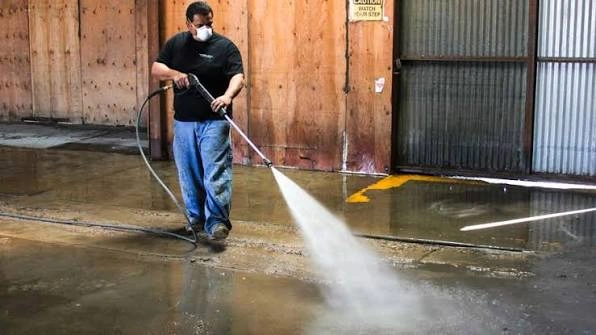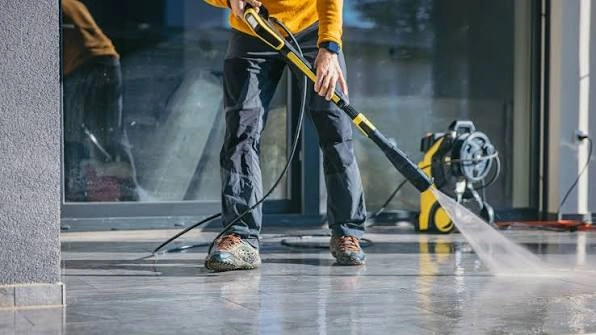
Before pressure washing concrete, you can spray it with a concrete-safe cleaning solution, detergent, or degreaser, depending on what you are trying to remove. A general concrete cleaner works well for dirt and grime, while a degreaser is more appropriate for oil and grease. Organic growth such as algae, mold, and mildew may require a cleaner specifically labeled for those stains.
Pre-spraying the surface helps loosen buildup before the pressure washer does the rinsing. This can produce a more even clean and may reduce the need to use excessive pressure. The right product matters, though. Concrete is porous, and the wrong chemical or concentration can discolor the surface or damage nearby plants, metal, paint, or other materials.
- What Should You Spray on Concrete Before Pressure Washing?
- What to Spray for Dirt and General Grime
- What Should You Spray on Concrete for Oil and Grease?
- What Should You Spray on Concrete for Algae, Mold, and Mildew?
- What About Tire Marks?
- What Are the Best Concrete Cleaners for Pressure Washers?
- General Concrete Cleaners
- Degreasers
- Outdoor Cleaners for Organic Growth
- Specialty Stain Removers
- How to Apply Cleaner Before Pressure Washing
- 1. Remove Loose Debris
- 2. Identify the Stain
- 3. Read the Product Label
- 4. Apply the Cleaner Evenly
- 5. Let It Work
- 6. Pressure Wash and Rinse
- Should You Wet Concrete Before Applying Cleaner?
- How Long Should Cleaner Sit on Concrete?
- What Chemicals Should You Avoid Mixing?
- Pressure Washing Tips for Concrete
- Start With a Test Area
- Do Not Start With Maximum Pressure
- Keep the Spray Moving
- Maintain a Consistent Distance
- Use a Surface Cleaner for Large Flat Areas
- Watch the Weather
- Common Mistakes When Pre-Treating Concrete
- Using Dish Soap Without Checking Compatibility
- Using Too Much Chemical
- Letting Cleaner Dry on the Surface
- Using the Same Cleaner for Every Stain
- Increasing Pressure Instead of Improving Preparation
- Can You Pressure Wash Concrete Without Cleaner?
- Can Household Bleach Be Used on Concrete?
- When Pressure Washing May Not Remove the Stain
- When Should You Hire a Professional?
- Final Thoughts
- FAQs
What Should You Spray on Concrete Before Pressure Washing?
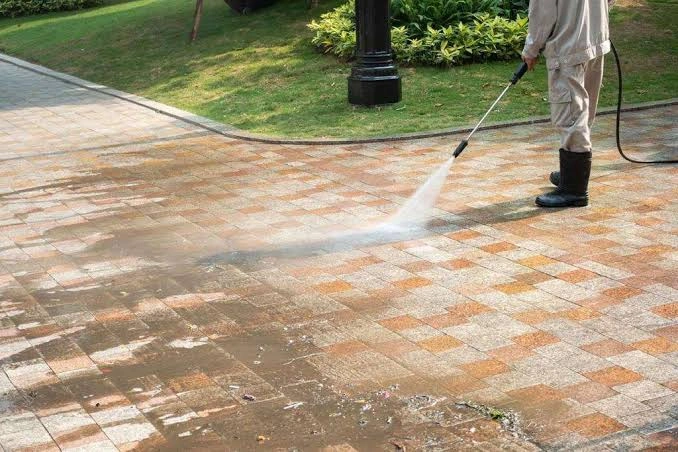
For most routine cleaning, start with a concrete cleaner or pressure-washer detergent that is labeled for concrete surfaces.
The best option depends on the type of buildup:
| Concrete Problem | Cleaner to Consider |
| Dirt and general grime | Concrete cleaner or pressure-washer detergent |
| Oil and grease | Concrete-safe degreaser |
| Algae, mold, or mildew | Appropriate outdoor cleaner for organic growth |
| Tire marks | Concrete cleaner or suitable degreaser |
| Rust stains | Specialty rust remover labeled for concrete |
| Heavy buildup | Professional-grade concrete cleaning product |
There is no single product that is the best cleaner for pressure washing concrete in every situation. A cleaner designed for oil may not be the right choice for algae, and a product intended for organic growth may not address deeply embedded grease.
Always read the product label for dilution, application, dwell time, surface compatibility, and rinsing instructions.
What to Spray for Dirt and General Grime
If the concrete simply looks dull, dirty, or weathered, you usually do not need an aggressive chemical.
A concrete-safe detergent or general-purpose concrete cleaner can help loosen:
- Dust
- Mud
- Road grime
- Food residue
- Outdoor dirt
- General surface buildup
Apply the product according to its label, allow it to work for the recommended amount of time, and then pressure wash the surface.
For lightly dirty concrete, water pressure alone may be enough. Pretreatment becomes more useful when the dirt has built up over time or has become difficult to remove with rinsing alone.
What Should You Spray on Concrete for Oil and Grease?
Oil and grease require a different approach because they can penetrate porous concrete.
A concrete-safe degreaser is generally more appropriate than a basic detergent. The product helps break down the oily material so the pressure washer can rinse away more of the loosened residue.
This is particularly useful on:
- Driveways
- Garage floors
- Parking areas
- Concrete around vehicles
- Areas beneath mechanical equipment
Do not assume that stronger pressure will solve an oil stain. Increasing pressure may clean the surrounding concrete while leaving the deeper oil contamination behind.
For an older or heavily embedded oil stain, several cleaning attempts may be necessary, and complete removal may not always be possible.
What Should You Spray on Concrete for Algae, Mold, and Mildew?
Green, black, or slippery growth on concrete is often associated with moisture and organic buildup.
For these surfaces, use a product specifically labeled for outdoor organic growth or a concrete-safe cleaner designed for the problem.
The cleaner should have time to work before pressure washing. Follow the manufacturer’s instructions rather than guessing at the concentration.
Be especially careful around:
- Grass
- Flower beds
- Shrubs
- Trees
- Pets
- Painted surfaces
- Nearby metal
Protect sensitive areas from unintended overspray and runoff.
What About Tire Marks?
Tire marks can be stubborn because rubber residue may adhere to the concrete rather than simply sitting on top of it.
A suitable concrete cleaner or degreaser may help loosen the marks. Apply it to the affected area, follow the product’s instructions, and then rinse with controlled pressure.
Avoid repeatedly concentrating a high-pressure stream on one small spot. If the mark does not respond, additional pressure is not necessarily the answer.
What Are the Best Concrete Cleaners for Pressure Washers?
The right concrete cleaners for pressure washers generally fall into a few categories.
General Concrete Cleaners
These are useful for ordinary dirt, grime, and weather-related buildup. They are a practical starting point when the concrete does not have a specific type of heavy stain.
Degreasers
Degreasers are intended for oily or greasy contamination. They are particularly useful on driveways and garage floors where vehicles regularly sit.
Outdoor Cleaners for Organic Growth
These products are designed to address buildup such as algae, mold, or mildew. Check the label to make sure the product is suitable for your specific surface.
Specialty Stain Removers
Rust and mineral deposits can require specialty products. Using a general detergent for every type of stain may produce disappointing results.
When comparing power washing chemicals for concrete, do not choose based only on how strong the product sounds. Surface compatibility and proper application are more important.
How to Apply Cleaner Before Pressure Washing
The application process is straightforward, but small details can affect the result.
1. Remove Loose Debris
Sweep the concrete first to remove leaves, dirt, stones, and other loose material.
This prevents you from turning loose debris into a muddy layer when the cleaning solution is applied.
2. Identify the Stain
Look at the surface before choosing the product.
Is it:
- General dirt?
- Oil?
- Grease?
- Algae?
- Mold?
- Tire residue?
- Rust?
Knowing what you are cleaning helps you choose a more appropriate product.
3. Read the Product Label
Check the label for:
- Dilution instructions
- Suitable surfaces
- Application method
- Recommended dwell time
- Required protective equipment
- Rinsing instructions
- Plant or environmental precautions
Do not guess the concentration when the manufacturer provides specific directions.
4. Apply the Cleaner Evenly
Use the application method recommended for the product. A pump sprayer, pressure washer detergent system, or other suitable applicator may be appropriate depending on the product.
Try to cover the surface evenly rather than creating heavily concentrated patches.
5. Let It Work
This is known as dwell time.
The cleaner needs enough time to loosen the buildup before you rinse it away. The correct time varies by product and stain, so follow the manufacturer’s instructions.
Do not allow the surface to dry out if the product specifically instructs you to keep it wet.
6. Pressure Wash and Rinse
After the appropriate dwell time, pressure wash the concrete using a suitable nozzle, pressure level, and technique.
Work systematically across the surface and rinse thoroughly.
Should You Wet Concrete Before Applying Cleaner?
It depends on the cleaning product.
Some products are intended for application to a dry surface, while others may call for pre-wetting. There is no universal rule that applies to every concrete cleaner.
The safest approach is to follow the product’s application instructions.
If the instructions are unclear, check the manufacturer’s directions before applying the chemical to the entire surface.
How Long Should Cleaner Sit on Concrete?
There is no single dwell time for every cleaning product.
A cleaner may need several minutes to loosen dirt, while a specialty product may have different instructions. Temperature, weather, surface condition, and the type of stain can also affect how the cleaning process behaves.
The important point is not to guess.
Follow the product label and keep an eye on the concrete while the cleaner is working. If the instructions say the surface should remain wet, do not allow the solution to dry before rinsing.
What Chemicals Should You Avoid Mixing?
Never mix cleaning chemicals simply because you think combining them will make the cleaner stronger.
Some chemical combinations can produce dangerous reactions or harmful fumes.
In particular, avoid mixing products unless the manufacturer explicitly states that they are compatible. Read every label before combining anything, and when in doubt, use one product at a time according to its instructions.
Also keep cleaning products away from children and pets and use the protective equipment recommended by the manufacturer.
Pressure Washing Tips for Concrete
Good preparation makes pressure washing easier and can help prevent surface damage.
Start With a Test Area
Test the cleaner and pressure washer on a less visible section first.
This lets you check for discoloration, unexpected surface reaction, or an unsuitable cleaning method.
Do Not Start With Maximum Pressure
More pressure is not automatically better. Use a suitable pressure setting for the condition of the concrete and increase only when necessary.
Keep the Spray Moving
Holding the wand in one location can create an uneven appearance or damage the surface.
Use controlled, overlapping passes instead.
Maintain a Consistent Distance
Changing the wand distance repeatedly can produce inconsistent cleaning. Keep your technique as consistent as practical.
Use a Surface Cleaner for Large Flat Areas
A surface-cleaner attachment can help clean large concrete areas more evenly than repeatedly using a wand.
This can be particularly useful for driveways, patios, and large walkways.
Watch the Weather
Extreme heat, direct sunlight, wind, or rapidly drying conditions can affect how a cleaning solution behaves.
If the product requires a specific application environment, follow those instructions rather than trying to improvise.
Common Mistakes When Pre-Treating Concrete
Using Dish Soap Without Checking Compatibility
A household soap is not automatically the right choice for pressure washing concrete. It may not be designed for the type of contamination you are trying to remove.
Using Too Much Chemical
More product does not necessarily mean better cleaning. Follow the recommended dilution and application rate.
Letting Cleaner Dry on the Surface
If the product instructions say to keep the surface wet, allowing it to dry can interfere with the cleaning process and may create residue.
Using the Same Cleaner for Every Stain
Oil, algae, rust, and ordinary dirt are different problems. Choosing the product based on the stain usually makes more sense than using one chemical for everything.
Increasing Pressure Instead of Improving Preparation
If a stain remains after pressure washing, the answer may be better pretreatment rather than more pressure.
Can You Pressure Wash Concrete Without Cleaner?
Yes. For lightly dirty concrete, water pressure may be enough to remove loose dirt and surface debris.
Cleaner becomes more useful when you are dealing with:
- Grease
- Oil
- Organic growth
- Deep grime
- Tire residue
- Long-standing stains
Pretreatment can make the cleaning process more effective because it loosens contamination before the pressure washer rinses the surface.
Can Household Bleach Be Used on Concrete?
Bleach-based products can be used for certain outdoor cleaning applications, but homeowners should not assume that any bleach product is automatically suitable for every concrete surface.
If using a bleach-based cleaner, follow the product’s instructions carefully and consider nearby plants, grass, pets, metal, painted surfaces, and runoff.
Never mix bleach with other cleaning chemicals unless the manufacturer specifically confirms compatibility.
A purpose-made concrete or outdoor cleaner may be easier to use because its instructions are designed around the intended cleaning application.
When Pressure Washing May Not Remove the Stain
Pressure washing is effective for many types of surface buildup, but it cannot guarantee that every discoloration will disappear.
Some stains can penetrate porous concrete or chemically react with the material. Examples can include older oil contamination, rust, paint, and certain mineral deposits.
If the stain remains after proper cleaning, repeatedly increasing pressure may do more harm than good.
At that point, the appropriate next step may be a specialty stain-removal product or professional evaluation.
When Should You Hire a Professional?
DIY cleaning can work well for smaller, straightforward jobs. Professional help may be more practical when the surface is large, heavily stained, damaged, or difficult to clean evenly.
Consider professional service if:
- The driveway has extensive oil staining
- Concrete has heavy organic growth
- You are unsure which chemical is appropriate
- The surface is old or deteriorating
- You need a large driveway cleaned evenly
- Previous pressure washing left streaks or marks
- You are concerned about chemical runoff
- You do not have the right equipment
For homeowners who need professional Driveway Washing in Tracy CA, a professional pressure washing company can evaluate the surface and choose an appropriate cleaning approach.
VJ Pressure Washing can also be considered when you want help cleaning concrete surfaces without having to determine the equipment, cleaner, and application process yourself.
Final Thoughts
If you’re wondering what to spray on concrete before pressure washing, the answer depends mainly on what is making the concrete dirty. A concrete-safe cleaner is suitable for general grime, a degreaser can help with oil and grease, and specialized outdoor cleaners may be better for algae, mold, or mildew.
Good preparation is often more useful than simply increasing pressure. Identify the stain, choose a compatible product, follow its dilution and dwell-time instructions, and test a small area before cleaning the entire surface.
With the right cleaner and careful technique, pressure washing can remove a wide range of buildup while helping protect the concrete underneath.
FAQs
What is the best thing to spray on concrete before pressure washing?
For general dirt, a concrete-safe cleaner or pressure-washer detergent is a practical choice. For oil and grease, use a suitable concrete degreaser. For algae or mildew, choose a product designed for that type of organic growth.
Should I use bleach before pressure washing concrete?
A bleach-based product may be appropriate for some outdoor organic growth, but follow the product’s instructions carefully. Never mix bleach with other chemicals unless compatibility is specifically confirmed.
Can I use dish soap on concrete before pressure washing?
It is better to use a product designed or labeled for the intended concrete-cleaning application rather than assuming household dish soap is suitable.
Do you need chemicals to pressure wash concrete?
No. Light dirt may come off with water pressure alone. Cleaning products become more useful for oil, grease, organic growth, and stubborn buildup.
How long should concrete cleaners sit before pressure washing?
Follow the cleaner manufacturer’s recommended dwell time. Avoid allowing the product to dry if the instructions say the surface should remain wet.
Should I pressure wash concrete with hot or cold water?
The appropriate water temperature depends on the equipment and type of contamination. Hot water can be useful for some grease-related cleaning applications, while many ordinary concrete-cleaning jobs can be handled with cold water and an appropriate cleaner.