Pressure washers are the best way to clean driveways, patios, decks, cars, siding, and a million things outdoors. They remove dirt, grime, mold, and stains at a pace that is far superior to traditional rubbing and scrubbing with their high-pressure water jets. However, many household or business owners are wondering: how much water does a pressure washer use?
This depends on several factors, such as the type of pressure washer you have, the flow rate, what you’re cleaning, and how long you run it. Knowing how much water a Pressure washer uses per minute can be invaluable information for users in making decisions regarding water consumption, efficiency, and operational costs.
- Understanding Pressure Washer Water Usage
- Average Pressure Washer Water Consumption
- Flow Rate
- How Much Water Does Pressure Washing Use per Hour?
- Water Usage of Pressure Washers
- Pressure Washing Water Efficiency
- Why Pressure Washing Water Efficiency Matters
- Factors Affecting Pressure Washer Water Consumption
- 1. Electric Pressure Washers
- Gas Pressure Washers
- Conclusion
- FAQs
Understanding Pressure Washer Water Usage
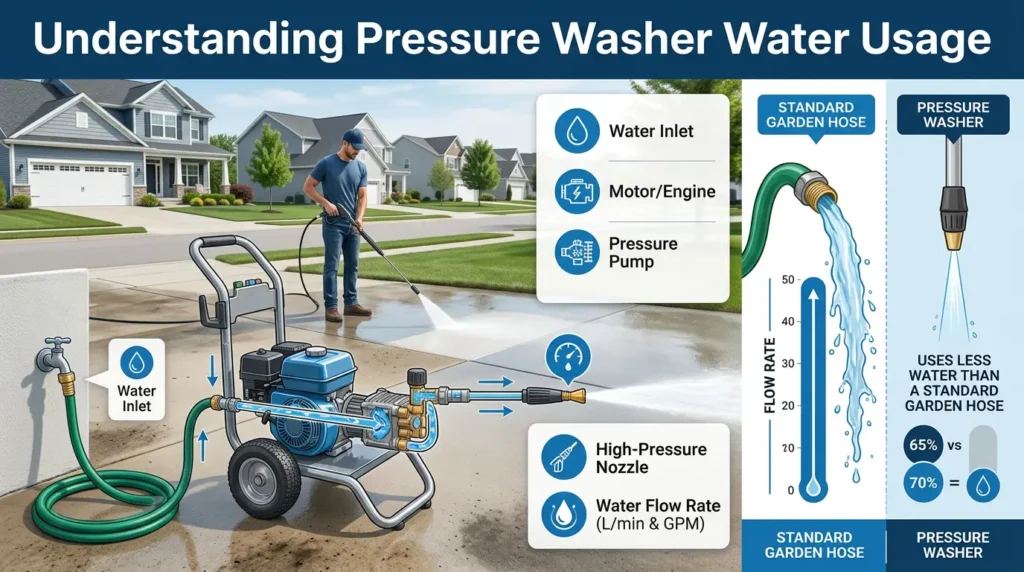
How much water does a pressure washer use? Before we get the answer, you should understand how pressure washers work. If you are looking for professional driveway power washing services in Tracy, CA (driveway power washing services tracy ca) our team has the expertise and equipment to get the job done efficiently while keeping water usage to a minimum.
Pressure washers use a motor or engine to pressurize the water and force it through a small orifice at high pressure. The pressure is high, but the total water consumption is usually much lower than what people anticipate.
Water consumption of pressure washers is generally expressed in litres per minute (L/min) or gallons per minute (GPM). It is this flow rate which determines the water used in a cleaning job.
Average Pressure Washer Water Consumption
Flow Rate
The most crucial aspect when you answer How much water does a pressure washer use? is the flow rate of the machine itself.
The water consumption of most residential pressure washers is between 6 and 12 litres per minute. Commercial and industrial units can consume as much as 15 to 30 litres per minute and beyond that.
Typical Pressure Washer Water Usage includes:
- Small electric units: 6-8 l/min
- Medium home models: 8-12 l/min
- Professional units: 12-20 litres per minute
- Industrial units: 20-30+ l/min
This gives you an idea of how much water certain equipment will make you use.
How Much Water Does Pressure Washing Use per Hour?
Many people like to be able to see how much water they are using at the hour level. Calculating the amount of water pressure washing uses is just the flow rate multiplied by 60 minutes.
For example:
- 8 litres per minute = 480 litres per hour
- 10 litres par minute = 600 litres par heure
- 15 litres par minute = 900 litres par heure
- 20 litres par minute = 1 200 litres par heure
Water consumption of airless painting machines: How much water is needed in airless painting machines? The duration for which the pressure washer is running determines how long the actual consumption lasts.
Water Usage of Pressure Washers
One “myth” is that pressure washers use too much water. Pressure washers may use less water than a garden hose.
Many garden hoses consume 15 to 25 liters of water per minute. A pressure washer may be more effective at cleaning and use only 8 to 12 liters per minute, whereas a hose consumes 15 to 25.
This leads to faster cleaning, with potentially less water consumption. Since water conservation is a concern, pressure washers often clean a surface more quickly with less water than a standard hose.
Pressure Washing Water Efficiency
One of the reasons pressure washers are so popular is their amazing Efficiency of water Pressure washing. Since the water is delivered at high pressure, it can dislodge dirt and debris much faster without the need for excessive amounts of water.
Better Pressure washing water efficiency also means users can finish cleaning jobs sooner – and use less water overall. This marriage of power and conservation makes pressure washing a viable cleaning option for home-based as well as office or retail applications.
Why Pressure Washing Water Efficiency Matters
Water conservation is now of great concern all over the world. Increasing Pressure washing Water efficiency enables homeowners and businesses to lessen their environmental impact. At VJ Pressure Washing, we are committed to delivering powerful cleaning results while keeping water usage as low as possible, helping both homeowners and businesses in Tracy, CA do their part for the environment.
Effective cleaning products and methods also reduce water and energy use as well as associated utility costs, and they promote the sustainable maintenance of building grounds.
Using water-efficient equipment is good for the user and good for the environment.
Factors Affecting Pressure Washer Water Consumption
Water consumption by pressure washers depends on several things.
These are:
- Machine size
- Pressure rating
- Flow rate
- Nozzle selection
- Cleaning surface
- Duration of operation
With this knowledge, users can make better estimations of water needs.
1. Electric Pressure Washers
Electric pressure washers are more often designed for household use and requirements. As for How Much Water Does Pressure Washing Use, electric models are usually the most water-efficient type.
The majority of electric models have a flow rate of 6 to 10L per min, which makes them perfect for small to medium cleaning tasks. Lower flow rates also mean better Pressure washing water efficiency.
Gas Pressure Washers
Pressure washers that run on gas are usually more powerful than those that run on electricity. The Flow rate of pressure washers in this range is usually between 10 and 20 litres per minute.
These units are designed for bigger cleaning jobs and may actually consume more water compared to smaller residential units. That said, they do tend to work faster because they clean better.
Conclusion
So how many litres of water does a pressure washer consume? This depends on the type of equipment, its flow rate, and the job that is being done. Most home pressure washers draw between 6 and 12 litres of water per minute, with larger models capable of using considerably more.
The truth is that the water consumption for pressure washers is usually less than what some people anticipate, particularly when compared with regular garden hoses. Together with superb Pressure washing water efficiency, pressure washers have proven to be one of the most effective and water-friendly cleaning systems available today. If you are looking for professional pressure washing services, feel free to contact us today and our team will be happy to help you clean smarter, save water, and get the best results for your home or business.
FAQs
Is it cheaper to use a pressure washer than a garden hose?
Yes. Since pressure washers use less water per minute than a standard garden hose and clean faster, they generally reduce both water consumption and time, lowering overall utility costs for regular cleaning tasks.
Can I use a pressure washer on all outdoor surfaces?
Not always. While pressure washers work well on concrete, brick, and driveways, delicate surfaces like wood, stucco, and painted walls require lower pressure settings or soft washing to avoid damage.
Does a higher pressure rating mean more water usage?
Not necessarily. Pressure rating (PSI) measures the force of water, while flow rate (L/min or GPM) measures water consumption. A machine can have high pressure but a low flow rate, meaning powerful cleaning with less water used.
How long does it take to pressure wash an average driveway?
Most average-sized driveways take 20 to 45 minutes with a residential pressure washer. At a flow rate of 8–10 litres per minute, that equates to roughly 160 to 450 litres of water for the full job.
Are electric or gas pressure washers better for water conservation?
Electric pressure washers are generally better for water conservation. With flow rates of 6 to 10 litres per minute, they use less water than gas models and are ideal for most household cleaning tasks where water efficiency is a priority.