
Yes, vinegar can help with certain types of driveway buildup, but it is not a universal driveway cleaner. It may be useful for small areas affected by algae, moss, or some light organic residue, but it is not the right solution for every stain or surface. Concrete and asphalt also require different considerations.Before pouring vinegar over an entire driveway, it is important to identify the surface, the type of buildup, and how severe the problem is.
Quick Answer
Can vinegar clean your driveway? Yes, vinegar can help treat some light organic growth such as moss and algae, but it is not an all-purpose driveway cleaner. It is less suitable for heavy oil, grease, deeply embedded dirt, and large areas of buildup. Use caution on concrete and test a small inconspicuous area first.
- Quick Answer
- Why Do People Use Vinegar to Clean Driveways?
- What Can Vinegar Actually Clean From a Driveway?
- Will Vinegar Damage a Concrete Driveway?
- Will Vinegar Damage an Asphalt Driveway?
- Will Vinegar Kill Algae on Concrete?
- How to Use Vinegar for a Small Driveway Cleaning Job
- 1. Remove Loose Debris
- 2. Protect Nearby Plants
- 3. Test a Small Area
- 4. Treat the Affected Area
- 5. Scrub Stubborn Areas
- 6. Rinse Thoroughly
- What Vinegar Does Not Clean Well
- Vinegar vs. Professional Driveway Cleaning
- Why Pressure Washing May Be More Practical for Large Driveways
- Common Mistakes When Using Vinegar on a Driveway
- Using Stronger Vinegar Without Understanding the Difference
- Treating the Whole Driveway for a Small Problem
- Ignoring Nearby Plants
- Leaving the Surface Untested
- Expecting Vinegar to Remove Oil
- Repeating Acidic Treatments Indefinitely
- What Is a Better Alternative to Vinegar for Driveway Cleaning?
- Key Takeaways
- Conclusion
- Frequently Asked Questions
Why Do People Use Vinegar to Clean Driveways?
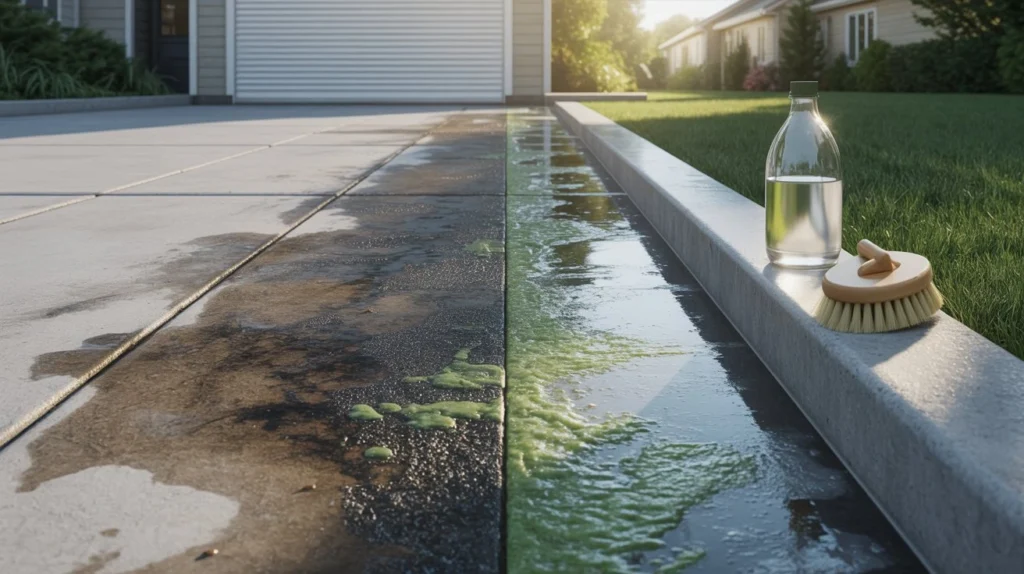
Vinegar is inexpensive, widely available, and contains acetic acid, which gives it acidic cleaning properties.
That makes it tempting for homeowners looking for a simple DIY driveway cleaner.
However, “natural” does not automatically mean that a cleaning solution is suitable for every surface.
Household vinegar commonly has an acidity around 5%, while some horticultural vinegar products contain substantially higher concentrations of acetic acid. Those stronger products can be much more aggressive and should not be treated like ordinary kitchen vinegar.
For driveway cleaning, the important question is not simply whether vinegar can clean something. The better question is:
What are you trying to remove, and what is your driveway made of?
What Can Vinegar Actually Clean From a Driveway?
Vinegar may be useful for certain types of organic buildup, particularly on small affected areas.
Potential applications include:
- Light algae growth
- Some moss growth
- Certain organic residues
- Small areas of surface buildup
- Some mineral-related deposits, depending on the material
Oregon State University Extension specifically lists vinegar as an alternative treatment for moss and algae deposits on pavement. Its guidance recommends treating the affected area and then washing the pavement afterward.
That does not mean vinegar is the best choice for every driveway.
For example, a driveway covered in automotive oil requires a different cleaning approach from a driveway with a thin layer of green algae.
Will Vinegar Damage a Concrete Driveway?
The answer depends on the type, concentration, frequency, and exposure, so it would be misleading to say that vinegar will always damage concrete or that it can never cause a problem.
Concrete is a cement-based, mineral surface, and acidic products can interact with mineral materials.
This is particularly important with stronger vinegar products. University of Maryland Extension warns that higher-acidity vinegar used as an herbicide can cause staining, mottling, etching, or other harm to masonry surfaces.
So, will vinegar damage concrete driveway surfaces? It can create a risk, particularly with stronger concentrations or repeated applications. For that reason, don’t assume that repeatedly soaking a concrete driveway in vinegar is harmless simply because household vinegar is commonly used around the home.
If you’re considering vinegar on concrete:
- Test a small, inconspicuous area first.
- Avoid unnecessarily strong vinegar products.
- Don’t leave the solution on the surface longer than necessary.
- Rinse the area thoroughly afterward.
- Keep the solution away from plants and sensitive surrounding materials.
If the entire driveway needs cleaning, a purpose-designed driveway cleaning method may be more appropriate than repeated vinegar treatments.
Will Vinegar Damage an Asphalt Driveway?
Will vinegar damage asphalt driveway surfaces? There isn’t a simple rule that ordinary household vinegar will automatically damage every asphalt driveway.
However, vinegar is still not a universal asphalt-cleaning solution.
Asphalt is different from concrete, and its surface condition can vary considerably. Older, weathered, cracked, or deteriorating asphalt should be treated carefully rather than experimenting with strong household acids.
If you are considering vinegar on asphalt, test a small area first and rinse thoroughly. Avoid using stronger horticultural vinegar simply because you believe a higher concentration will clean faster.
For general dirt, road film, and larger areas of buildup, a cleaning method designed for the specific pavement surface is a more controlled choice.
Will Vinegar Kill Algae on Concrete?
It can help treat algae and moss on pavement, but the result depends on the growth, surface conditions, and treatment method.
Oregon State University Extension lists vinegar as one option for treating moss and algae deposits on pavement and recommends washing the driveway afterward.
So, will vinegar kill algae on concrete? It can be useful for small patches, but don’t confuse treating visible algae with permanently solving the conditions that caused it.
Algae and moss tend to become more persistent where surfaces remain damp and shaded.
After removing the growth, look at the surrounding conditions.
For example:
- Are sprinklers repeatedly wetting the driveway?
- Does water remain on the pavement?
- Are trees blocking sunlight?
- Is drainage poor?
- Is organic debris collecting along the edges?
Fixing those conditions can help reduce recurring growth.
How to Use Vinegar for a Small Driveway Cleaning Job
If you have a small area of algae or moss and have decided that vinegar is appropriate for the surface, keep the process controlled.
1. Remove Loose Debris
Sweep away leaves, dirt, twigs, and other loose material.
There is little benefit in applying a cleaning solution over a layer of debris.
2. Protect Nearby Plants
Vinegar can affect plants that it contacts.
University of Maryland Extension specifically warns that vinegar-based herbicidal products can damage desirable vegetation through spray drift or direct contact.
Cover or move vulnerable plants where appropriate, and avoid runoff into garden beds.
3. Test a Small Area
Choose an inconspicuous section first.
Apply your intended cleaning method and observe the surface after rinsing and drying.
Look for any unexpected discoloration or surface change.
4. Treat the Affected Area
Apply the vinegar only where it is actually needed rather than automatically covering the entire driveway.
For moss and algae, Oregon State University Extension describes allowing a vinegar treatment to remain on the growth before washing the pavement afterward.
Follow the product instructions if you’re using anything stronger than ordinary household vinegar.
5. Scrub Stubborn Areas
A stiff brush can help loosen growth that remains attached to the pavement.
Physical removal is particularly useful when the buildup has formed a visible layer.
6. Rinse Thoroughly
Once you’ve finished treating and scrubbing the area, rinse the pavement thoroughly.
The goal is to remove remaining cleaning solution and loosened material rather than leaving residue behind.
What Vinegar Does Not Clean Well
One of the biggest mistakes homeowners make is expecting one DIY ingredient to handle every driveway stain.
Vinegar isn’t a magic solution for:
- Heavy oil stains
- Deep grease
- Large areas of embedded dirt
- Tire-related buildup
- Old, deeply set stains
- Thick layers of grime
- Major surface contamination
For example, if a vehicle has leaked oil onto the driveway, the problem is substantially different from a small patch of algae.
Using vinegar simply because it is available may waste time without addressing the stain effectively.
In those situations, a suitable degreasing or driveway-cleaning product may be more appropriate.
Vinegar vs. Professional Driveway Cleaning
A DIY vinegar treatment can make sense when the problem is small and clearly identified.
Professional driveway cleaning becomes more useful when:
- The entire driveway is heavily soiled.
- Dirt is deeply embedded.
- There are multiple types of stains.
- Algae or moss covers a large area.
- The surface has become slippery.
- You don’t have the time or equipment to scrub the driveway.
- You are unsure which cleaning method is appropriate.
- The pavement is already weathered or damaged.
Professional cleaning also allows the cleaning approach to be matched to the surface rather than treating every driveway with the same household solution.
For homeowners who want professional help with exterior pavement maintenance, VJ Pressure Washing provides driveway cleaning services.
If you’re specifically looking for Driveway Washing in Tracy CA, the service can be a more practical option when DIY spot treatment is not enough.
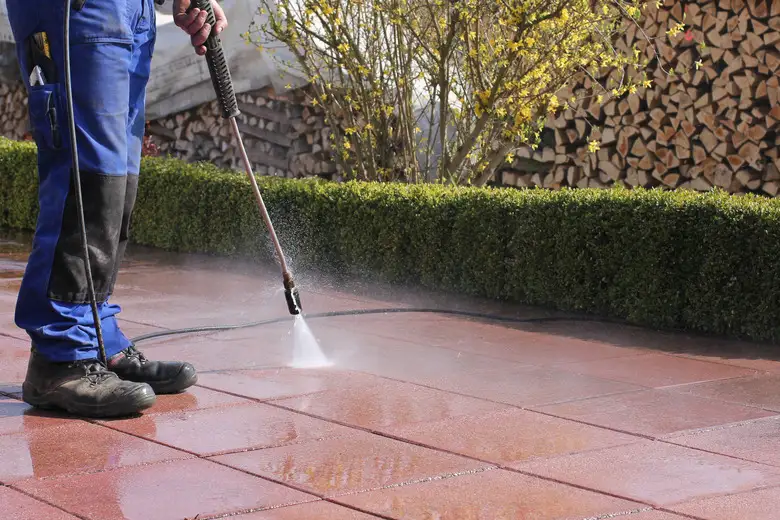
Why Pressure Washing May Be More Practical for Large Driveways
A large driveway can contain hundreds of square feet of surface area.
Applying vinegar, waiting, scrubbing, and rinsing every section manually can become a time-consuming project.
Pressure washing can help remove loose dirt and surface buildup more efficiently, but it still needs to be used correctly.
Too much pressure or an unsuitable technique can damage some surfaces.
The right approach depends on factors such as:
- Concrete condition
- Asphalt condition
- Surface age
- Existing cracks
- Type of staining
- Nearby landscaping
- Amount of buildup
The objective should be effective cleaning without unnecessarily stressing the pavement.
Common Mistakes When Using Vinegar on a Driveway
Using Stronger Vinegar Without Understanding the Difference
Horticultural vinegar can contain much more acetic acid than household vinegar. Stronger does not automatically mean safer or better for driveway cleaning.
Treating the Whole Driveway for a Small Problem
If algae is present in one corner, there may be no reason to cover the entire driveway with a cleaning solution.
Spot treatment can be more controlled.
Ignoring Nearby Plants
Runoff and overspray can reach grass, flowers, shrubs, and other vegetation.
Leaving the Surface Untested
Different surfaces can react differently. A small test area is a simple precaution.
Expecting Vinegar to Remove Oil
Vinegar is not the first choice for heavy automotive oil or grease.
Repeating Acidic Treatments Indefinitely
If algae keeps returning, address moisture, shade, drainage, and debris instead of repeatedly applying vinegar.
What Is a Better Alternative to Vinegar for Driveway Cleaning?
The right alternative depends on the problem.
| Driveway Problem | More Appropriate Approach |
| Loose dirt | Water and appropriate surface cleaning |
| Light organic buildup | Scrubbing and suitable exterior cleaner |
| Small algae or moss patch | Controlled treatment followed by thorough rinsing |
| Oil or grease | Suitable degreaser and mechanical cleaning |
| Large-area grime | Driveway cleaning or pressure washing |
| Persistent buildup | Identify the cause before choosing a cleaner |
| Damaged pavement | Assessment before aggressive cleaning |
The key is to match the cleaning method to the stain instead of assuming one household product can handle everything.
Key Takeaways
- Vinegar can help with some small areas of algae, moss, and organic buildup.
- It is not an all-purpose driveway cleaner.
- Stronger vinegar products can damage masonry and should be handled carefully.
- Household vinegar should not automatically be considered the best solution for concrete or asphalt.
- Vinegar is not the ideal first choice for heavy oil and grease stains.
- Always test a small area and protect nearby plants before treating pavement.
- Large or heavily contaminated driveways may be better suited to professional cleaning.
Conclusion
So, Can Vinegar Clean Your Driveway? Yes, but only for certain cleaning situations.
Vinegar can be useful for small patches of moss or algae, but it should not be treated as a universal solution for concrete, asphalt, oil stains, grease, and heavy grime. Stronger vinegar products also require extra caution because high concentrations of acetic acid can damage surfaces and surrounding vegetation.
Before using vinegar, identify the driveway material and the type of buildup you’re dealing with. Test a small area, protect nearby plants, avoid unnecessarily strong products, and rinse the surface thoroughly.
For a small DIY problem, that may be all you need. If the driveway has widespread buildup, stubborn stains, or recurring organic growth, professional cleaning can save time and provide a more controlled approach.
Frequently Asked Questions
Can vinegar clean your driveway?
Yes, vinegar can help with certain types of surface buildup, especially small areas of moss or algae, but it is not a complete driveway-cleaning solution. Its usefulness depends on the surface and type of stain.
Will vinegar damage concrete driveway surfaces?
It can. Stronger acidic vinegar products may cause etching, staining, or other surface damage to masonry. Repeated or inappropriate use should therefore be avoided.
Will vinegar damage asphalt driveway surfaces?
Household vinegar should not automatically be assumed to damage every asphalt driveway, but it is not a universal asphalt cleaner either. Test a small area first and avoid unnecessarily strong products.
Will vinegar kill algae on concrete?
Vinegar can be used as one treatment option for moss and algae on pavement. Oregon State University Extension recommends treating the growth and then washing the pavement afterward.
Can vinegar remove oil stains from a driveway?
Vinegar is generally not the most suitable choice for heavy oil and grease. A cleaner specifically designed to break down petroleum-based stains is more appropriate.
Can I use horticultural vinegar to clean my driveway?
Be careful. Horticultural vinegar can have a much higher acetic acid concentration than household vinegar and may cause surface or plant damage. It should not be treated as an ordinary household cleaner.
Should I dilute vinegar before using it on concrete?
There is no single dilution that can be recommended for every concrete driveway and every cleaning problem. The safest approach is to use a product specifically intended for the surface, follow its directions, and test any DIY treatment on a small area first.
Is vinegar better than pressure washing?
Neither method is automatically better for every situation. Vinegar may be practical for a small, specific area of organic growth, while professional pressure washing can be more practical for large areas of dirt and buildup.
How can I stop algae from returning to my driveway?
Look for the conditions supporting growth, such as persistent moisture, shade, poor drainage, or sprinkler overspray. Reducing those conditions can help limit recurring algae and moss.